Showing posts with label kim dotcom. Show all posts

Saturday, 31 August 2013

Rainbow's End with Roving Spheres


With the passage of the GCSB Amendment bill by just a couple of votes, such a move towards mass surveillance has polarised New Zealanders. Those in favour of this creeping illiberality typically invoke the hoary old "if you have nothing to hide, you have nothing to fear" argument, which has been popularly attributed to a number of repressive dictators in history. It's been mentioned as early as the late 19th century:
"If these people had done bad things they ought to be ashamed of themselves and he couldn't pity them, and if they hadn't done them there was no need of making such a rumpus about other people knowing."
Just to rub it in, the NZ Police have declined to press charges involving the GCSB wilfully straying outside of its lawful jurisdiction, claiming there was no evidence of 'criminal intent'. To privacy advocates, it gives the impression of a Government agency given carte blanche to be a law unto itself.

Not surprisingly, hacker collective Anonymous has announced it's expanding its operations in NZ. Already they've defaced the web sites of the GCSB and various Government ministers who voted for the law changes, and have promised more. Kim Dotcom, a cause celebré of the Internet privacy movement, has come out against such defacement, saying it only gives supporters of cyber-snooping more ammunition.


On the other hand, with the Key Government seemingly unstoppable and a political Opposition still to get its act together, JFK's wisdom comes to mind: "Those who make peaceful revolution impossible, will make violent revolution inevitable." Only this time, there are no guns or bombs, only laptops and the Internet.

Already, those who increasingly speak out against the Government - Natasha Fuller, Mike Joy, Jon Stephenson - are come down upon with the full force of its propaganda machine. Recent proposals to ban protests against offshore oil drilling only consolidate such intolerance of dissent. If Singapore is "Disneyland with the Death Penalty" according to William Gibson, then NZ is increasingly becoming Rainbow's End with Roving Spheres.

And then there were three...


It was only a matter of time before the Leader of the Opposition, David Shearer, would throw in the towel. From Day 1, he gave the impression of being parachuted into the role, and struggled to come across as coherent. And the timing of his resignation was a bit off. Yet if he makes it to Cabinet, he'd probably be effective in the Foreign Affairs portfolio, his old stomping ground.

Jostling for the newly vacated seat are David Cunliffe, Grant Robertson, and Shane Jones, who each represent different segments of the public voter base.

David Cunliffe


Cunliffe comes across as the "broad church" candidate who happens to be very focused about his policy platform, with a Fulbright scholarship and Harvard MPA (not MBA) to boot. He manned up and unbundled Telecom's local loop in 2006 in the face of resistance from the finance sector, which had profited handsomely from a cartellised telco market. To his detractors, he comes across as an aloof prima donna, and seems to be far more popular with the party rank-and-file and public than within his own caucus. Still, much of the NZ Labour caucus is weighed down with dead wood, and he probably has the best chance of taking on John Key at his own game.

Grant Robertson


Robertson is seen as the "beltway insider". I'm not a big fan of the term "beltway" in a NZ context, because it's been invoked to dismiss burning issues like the GCSB as not being on the public radar. He has a good grip on how the machinery of Government works, and holds his own in the Parliamentary debating chamber. Supposedly counting against him is his open homosexuality, following the controversy over the legalisation of same-sex marriage. Such arguments are playing the man instead of the ball (and Robertson is a keen follower of the rugby scene), though, and I'm firmly of the view that Robertson's sexual orientation is a non-issue. If anything potentially counts against him, it's his Wellington insider status which only those with a fascination for politics are seen to be interested in. He's still a solid candidate who's done the hard yards in his electorate Wellington Central, and would make the perfect deputy leader.

Shane Jones


Jones is the "red-blooded" or "Waitakere Man" candidate who was in the news for the wrong reasons not too long ago, namely for charging porno flicks to the taxpayer. He has swing voter appeal, where modern elections are supposedly won and lost, and like Cunliffe went to Harvard and has a grounding in business. However, his red-bloodedness has gotten him offside with environmentalists and women, and his relations with the Green Party will prove rather interesting if he becomes a Cabinet minister.
While Jones is an outside chance for the leadership, he'll still be effective on the front bench despite his personal flaws.

More pork


Finance Minister Bill English doled out a NZD $30 million subsidy to mining giant Rio Tinto, in order to settle an impasse over the future of the Tiwai Point aluminium smelter, which has been under the threat of closure and hence massive job losses and the associated divider effect. Another side effect of Tiwai Point's closure would be a sudden drop-off in power usage - the smelter consumes about 14% of NZ's total electricity generation - which would flood the electricity market and cause power prices to fall.

As there's no guarantee the smelter will remain open after 2017, the subsidy isn't about smelter jobs and the Southland economy. It's really about fattening up Meridian Energy, the provider of electricity to the smelter, for floating on the sharemarket. While public services like the Department of Conservation are laying off staff and we're lectured about the cupboard being bare, the Government of the day somehow manages to find large sums of money to subsidise highly profitable multi-nationals. Bill English, from an old-school Treasury background, is telling us to do as he says, not as he does. If it isn't socialism for the rich and austerity for the rest of us, I don't know what is.

If a Labour-led Government was in the same position, it might have screwed down Meridian Energy or put in a jobs readjustment plan for a post-smelter future, both of which would be anathema to the increasingly discredited and hypocritical Wall Street orthodoxy that those currently in power cling to at all costs.

Monday, 31 December 2012

2012: the year in review

2012 has come to a close, and we're still waiting for the doomsday predictions in the Mayan calendar. With all that aside, here's to 2013.

The Mega Conspiracy & Pacific Fibre


Kim Dotcom appears to have started turning the tables on the MAFIAA and its hangers-on. He's won the right to sue the authorities involved, And his latest venture, simply named Mega, is not too far off.

More interestingly still, he's thought out loud of resurrecting the Pacific Fibre proposal, which was abandoned by its original backers due to insufficient capital. One of my customers has theorised, with some justification, that Pacific Fibre was just an elaborate warning shot to Telecom's Southern Cross Cable. Given that NZ's internet traffic is largely global, a second undersea cable is probably a more pressing priority than a domestic fibre network. Dotcom's proposal to enact it in practice remains to be seem.


Journalism vs churnalism


The Leveson Inquiry reported back its findings on the Hackgate affair, and it's recommended a new independent regulatory agency. Needless to say, it's caused some polarisation. Hacked Off, the NGO representing those whose privacy has been invaded by the News of the World and other tabloid outlets, are in support. More interestingly still, support for Hacked Off came from the most unlikely quarter - Salman Rushdie. Reporters Without Borders favours a proceed with caution approach. Closer to home, the Law Commission has explored similar territory but for different reasons.


Critics of the Leveson Inquiry suspect it's a slippery slope to state control of the British media, and therefore, censorship. Such negative reactions have tended to come from those profiting handsomely from sensationalism, who argue they're just meeting public demand. Additionally, they tend to gloss over the incestuous relationship between politicians, law enforcement and tabloid reporters that characterised Hackgate. Kenan Malik has a far more nuanced argument against the Leveson Inquiry - that it attacks the symptom rather than the toxic culture underpinning publications like News of the World. Sir Joh's Queensland is a case in point of what could happen when media regulations are misused for outright censorship.

A free Fourth Estate is vital to holding public figures to account, but Hackgate has exposed the ethical bankruptcy of many media proprietors. In fact, Hackgate was exposed in the first place by Nick Davies of The Guardian, through good old-fashioned investigative journalism. A Press Council/BSA structure with much sharper teeth would be ideal, particularly where rulings tend to be buried on a sidebar in page 9. The closest match would probably be Denmark and Finland, which have been ranked at the top of Reporters Without Borders' Press Freedom Index but still have official statute underpinning it. The rise of the blogosphere adds another dimension into the mix, but chances are it won't displace traditional media just yet.

Gun politics


The spree killing of primary school kids in Sandy Hook, Connecticut by a mentally unhinged young man re-ignited the gun politics debate in America - still raw from the Aurora shootings and the Trayvon Martin incident - with conflicting reports on whether the National Rifle Association was gaining or losing members. It was too much for even Rupert Murdoch. And the Sandy Hook shooter's mother - herself one of the victims - was a 'prepper' survivalist who died in the most ironic manner - her own cache of guns ended up being used against her. And preppers are the very people that NRA president Wayne La Pierre appeal to.

Things came to a head when CNN anchor and former Daily Mirror editor Piers Morgan went ballistic on Gun Owners of America president Larry Pratt. Morgan isn't renowned for his subtlety or good character, but he wasn't afraid to call a spade a fucking shovel on the Sandy Hook tragedy. Despite a petition to have him deported from the States, Morgan has refused to get cold feet. And if it's anything to go by, Pratt makes the NRA look like Mahatma Gandhi. He's hobnobbed with white supremacists and religious fundamentalists in the recent past, despite denials to the contrary.


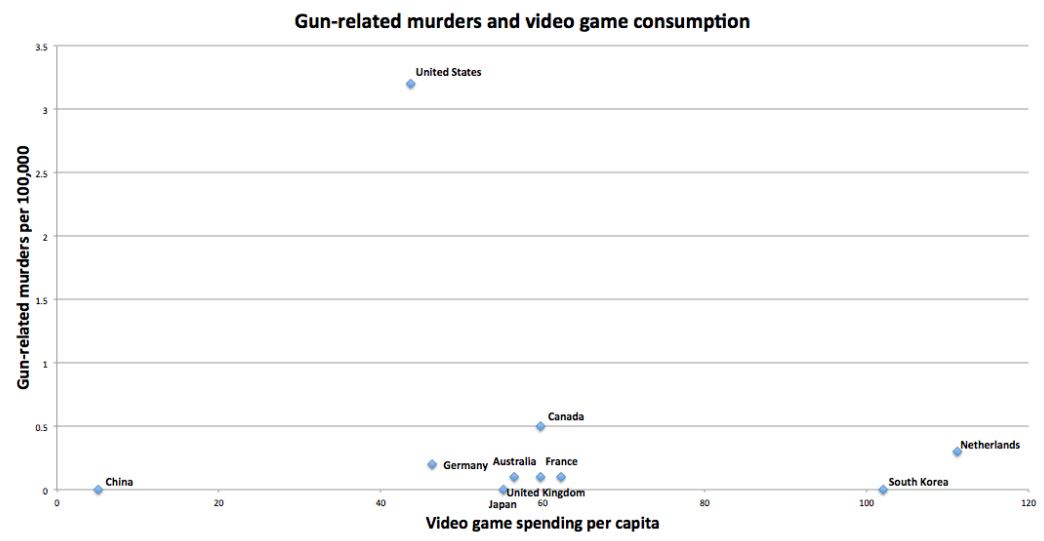
Video games and movies have long been scapegoated by gun lobbyists for spree shootings. Yet other industrialised nations play the very same games and watch the very same movies that the Americans do, and still have much lower gun homicide rates - and general homicide rates for that matter. Michael Moore had a point in Bowling for Columbine when he observed that Columbine shooters Eric Harris & Dylan Klebold were ten-pin bowling enthusiasts, so should bowling be banned because it makes people go on spree shootings? The classic Hitler Ate Sugar fallacy never seems to go away.


It's also far easier to kill with an automatic rifle than with a knife. A deranged man in China attempted to stab a couple of dozen school kids earlier this year, yet there was not a single fatality.

So why are automatic firearms legally allowed to be purchased domestically in America, but not other industrialised nations? Certainly not for hunting - even a powerful enough 12-gauge can bring the angriest grizzly bear to heel. And not one of these rifles has known to be used in self-defence - pistols usually have that covered, and even then that's been the exception rather than the rule.
Outside of the battlefields of Afghanistan and Normandy, there's a school of thought that the real purpose of possessing assault rifles is survivalist paranoia. Specifically two reasons: overthrowing a "tyrannical government", which was a real threat when the 2nd Amendment was drafted in 1776, but comes across as conspiracy theory fantasy today; and race war, one of the primary fears of a chauvinist born-to-rule order facing the weakening of its monopoly on power.

2 + 2 = 5


The Novopay debacle continues to leave teachers in the lurch, and for good reason. Already, the Education Secretary Lesley Longstone has resigned, not long after she was parachuted into the role from Britain. Education Minister Hekia Parata effectively continues to deny responsibility, blaming everyone but herself.

In true Orwellian fashion, the ruling Government's promises to reverse the "brain-drain" in 2008 with tax cuts has been double-spoken into a "brain exchange". NZ has always had restless youth visiting and working overseas, and often returning and bringing back valuable know-how. But to imply that taxation alone drives talented NZers overseas is a cynical exercise in saying black is white, given we're at the lower end of the OECD taxation scale. Even if NZ reduced its taxation levels to that of, say, Monaco, NZers would still go overseas. For the simple fact that there are only 2 degrees of separation among us, and we've long been a couple of small islands in the middle of a large natural moat. We'll never be London or Los Angeles or Sydney, and nor should we delude ourselves that we can pray to the cargo cult and become them.


We can, however, carve our own niche in the wider world. The Internet has reduced our distance to the world and fostered innovation somewhat, but it's still at the whim of a cartellised communications sector. And the prevailing economic orthodoxy in NZ goes a long way to explaining NZ's relatively high living costs - it's not really pro-business, but pro-cartel. Those who conspire to keep it in place would do well to read Book I, Chapter X, Part II of Adam Smith's The Wealth of Nations:
"People of the same trade seldom meet together, even for merriment and diversion, but the conversation ends in a conspiracy against the public, or in some contrivance to raise prices. It is impossible indeed to prevent such meetings, by any law which either could be executed, or would be consistent with liberty or justice. But though the law cannot hinder people of the same trade from sometimes assembling together, it ought to do nothing to facilitate such assemblies; much less to render them necessary."

Sunday, 13 May 2012

Plots thicken, #2

The Dotcom bombshell


It's emerged Kim Dotcom donated $50,000 to John Banks' mayoral bid in 2010, and what does Dotcom get in return? No help from Banksie after he gets raided by the police and the FBI. Now Dotcom seems to have spilled a few beans - a tad too many beans for Banks to be comfortable with.


Namely the allegation that Banks asked for the donations to be split in 2 payments so that they could be declared anonymous, only for Banks to deny all knowledge when Dotcom went public. Additionally, Sky City Casino made $15,000 donations each to Banks and Len Brown - every man has his price, but at least Brown was honest about it.

Under electoral law, anonymous donations where the recipient knows the donor's identity are potentially illegal, and the Opposition has for once made hay from it. If found in breach of the law, Banksie will be required to resign from Parliament, forcing a by-election which the Government would find rather inconvenient. The whole thing's like a McPhail & Gadsby episode, only completely improvised.

It seems what goes around, comes around - Helen Clark was accused of propping up Winston Peters in the final term of her government while Peters was investigated for undeclared donations from transport tycoon Owen Glenn. But now John Key finds himself under fire for doing the exact same thing with Banksie. Because he needs the numbers to sell off what we still own to faceless Wall Street suits.

Freakonomics and wedge politics


The Government's proposed contraception measures for DPB recipients is a nice one in theory, and I'm all for measures that make contraception more accessible to those difficult to reach. But it'll all be for nothing if it turns out to be little more than state control of the gene pool by stealth, which I suspect a certain section of the public wants.

In chapter 4 of Freakonomics, Stephen Levitt and Stephen J. Dubner made a connection between falling crime rates in America towards the end of the 20th Century, and legalised abortion following the Roe vs Wade ruling in 1973. They suggested that legalised abortion led to fewer unwanted babies, and fewer unwanted babies meant fewer career criminals. What Levitt and Dubner also found was that it all happened by accident, with little if any imposition from the state.

Levitt & Dubner's observations suggest that for contraception to be effective, it needs to be not just widely accessible, but also free of state coercion and free of stigma, something that Social Welfare Minister Paula Bennett needs to take heed. But from what's been announced so far, she seems to be putting the 'promiscuity' stigma back into contraception, and Conservatives leader Colin Craig is effectively playing the 'uncovered meat' card. Paul Little notes in the NZ Herald that it's also applying to the daughters of welfare mothers, which gives the implication of what Little calls the 'slut gene'. Minister Bennett might as well encourage the poor to take up a few modest proposals.

The welfare contraceptives issue is just one subset of divide-and-rule politics being mercilessly exploited in times of economic turbulence, if comments on Talkbackistan and the news web are anything to go by. It worked for John Howard with the infamous Big Lie known as the Children Overboard Affair. Economics professor Robert Reich noted in his video, The Truth About The Economy, that the middle and working classes are too busy fighting amongst themselves to focus their attention on the One Percenters responsible for their predicament.
 also written of the "last place aversion paradox", where those near the bottom oppose measures to reduce the wealth gap because it would mean the very bottom would surpass them.

The 'prosperity gospel' relentlessly preached in the last generation has fomented unrealistic expectations that we can all have a sprawling McMansion and a Hummer in the driveway, and a latent inferiority complex in those who would otherwise challenge the One Percenters. When peoples' attempts to climb the social ladder are thwarted, they start taking out their anger on those below them. In 1930s Europe, exploitation of latent inferiority complexes - brought on by the Great Depression and the Treaty of Versailles - got cranked up to eleven, and the rest is history.


In the words of a commenter on a recent Guardian article about civil unrest from the Great Recession:
Sweet Jesus. No one is going to fix this mess, are they? No politician seems up to the job. 
This week I heard a pefectly sensible guest on Radio 4's Moneybox, use the phrase "when the balloon goes up" without any sense of irony whatsoever. I've recently read three level-headed articles predicting the end of the "marriage of convenience" between capitalism and democracy. 
I'm scared. Proper Weimar Republic scared.